In this post, you’ll learn about the four foundational types of brand stories to use in your marketing:
Your Origin Story
Purpose Stories
Process Stories
Impact Stories
These four story types are the way to get your audience’s attention and help them remember what you say, feel something, and take action.
Why Your Business or Nonprofit Needs to Be Telling Powerful Stories

Story has always mattered.
Now it matters even more.
Think for a moment about what makes us human. Abilities like complex communication, advanced cognition, creativity, storytelling, and relationship-building likely come to mind.
According to research by Drs. Mark Plitt, Ricky Savjani, and David Eagleman, the human brain perceives brands as if they are people. So, consumers expect businesses to communicate clearly, demonstrate creativity, tell engaging stories, and connect meaningfully.
Now, consider the things that generative AI takes off our proverbial plate—things like communication, storytelling, and connection. It’s easy to see the potential dangers it presents.
The rapid adoption of AI tools has changed the way many people communicate and access information. For businesses, there has been pressure to get into the AI race or risk being left behind. Unfortunately, for every thoughtful application of these new technologies, there are dozens of examples of brands that are unintentionally eroding all they've built by relying too heavily on AI for content creation.
When we stop synthesizing information, communicating original ideas, and telling stories, we risk losing those skills over time. And when we put AI tools between us and our audience, we create new barriers to genuine human-to-human connection.
It's not realistic to expect AI to disappear or to avoid using it altogether. Still, we must be incredibly thoughtful about how we engage and conscious of the tradeoffs.
If there is one thing you can do right now to reinforce the humanity of your brand, it is to get really good at telling stories.
As a copywriter with decades of training and experience in theater, storytelling has always been deeply embedded in my approach. Let’s dive into the four foundational types of stories you need in your toolkit to communicate powerfully and connect authentically in this new marketing landscape.
The Origin Story
What is an Origin Story?
The story of how your business or organization came to be and WHY you exist.

Your business didn’t happen by accident. Whether it was born of a lifelong dream, a personal struggle turned purposeful, or to fill a need you saw in the market, there was a reason you built it.
A powerful brand origin story inspires your team, piques the interest of partners and investors, and resonates with the hearts of your ideal customers.
To craft your origin story, start by reflecting on all of the life experiences that led you toward the moment when you began your business. You don't need to incorporate all of these; in fact, you shouldn't! Instead, identify a significant moment that:
illuminates your brand purpose
is relatable to your target audience
sparks emotion
Take Warby Parker, for example. In their origin story, they identified a relatable moment that was the catalyst for their business idea. Here's an excerpt from Warby Parker’s origin story:
. . . Every idea starts with a problem. Ours was simple: Glasses are too expensive.
Our founders were students when one of them lost his glasses on a backpacking trip. The cost of replacing them was so high that he spent the first semester of grad school without them, squinting and complaining. (We don't recommend this.) . . .
They use specific details and emotion to capture this moment, and then continue to explain the problem they set out to solve, as well as their mission, values, and differentiators, in the remaining paragraphs of their story.
While no two brand origin stories are exactly alike, it’s important to take readers on a journey that begins with life before your business existed, invites them into the moment that changed everything, and shares how your business was built to meet that moment.
Purpose Stories
What are Purpose Stories?
Stories that build upon your why using relatable micro-moments that demonstrate how you pursue your purpose and activate your values.
While your purpose should feature prominently in your origin story, that one story isn’t enough!
By regularly incorporating stories that highlight your brand’s purpose, you reinforce your positioning and become more memorable to consumers. Purpose Stories are also an excellent way to inspire your team.
Purpose Stories can center on problems you see that you’re committed to solving or on moments when your brand acted in alignment with your mission and values.
Here are some prompts for brainstorming purpose stories:
A moment we drew a line in the sand and acted in alignment with our values
A time when our purpose evolved to meet the changing needs of our customers or the world
An example of how our product or service did good in the world
A current event or news story that demonstrates the need for your product or service
Process Stories
What are Process Stories?
Behind-the-scenes stories that help your audience feel like insiders while reinforcing your positioning in the market and the value of what you offer.
Process Stories are all about highlighting your differentiators and building connection through behind-the-scenes moments.
People like to feel like insiders. Process stories help to build trust through transparency, show what you do differently from competitors, and humanize your brand. These kinds of stories can also demonstrate the value of your product or service by showing all that goes into it.
AI can't replicate these authentic glimpses into your business's day-to-day operations, making them even more valuable in the current marketing landscape.
Here are some Process Story ideas to get you started:
Team member spotlights
Maker moments
Previews of new product development
How you problem-solved a challenge
Things you do differently from others in your industry
Unglamorous moments that result in a better quality product or service
I personally love a great story about how something is made. I think the fascination goes back to watching the Mr. Rogers' Neighborhood episode where they took viewers on a trip to a crayon factory.
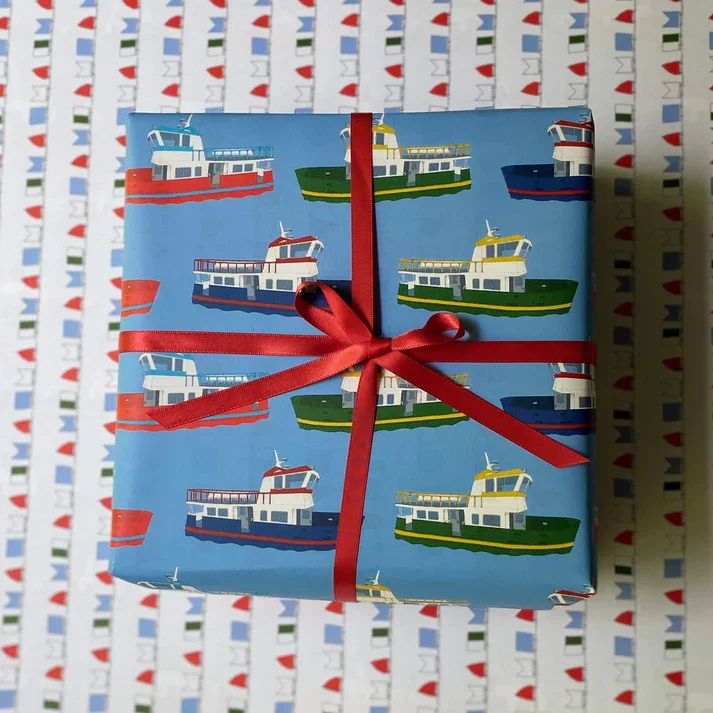
One local small business that shares some fantastic maker stories is Ballard & Prescott. Founder Anna Ballard's mission is to make elegant gifting easy with the help of her personalized service, curated gift options, and custom-designed wrapping paper.
Ballard & Prescott’s social media feeds often feature stories about the inspiration behind and creation of each seasonal wrapping paper design, like this ferry-inspired paper.
Impact Stories
What are Impact Stories?
Transformation stories that show how people’s lives have been improved by your business or organization.
Impact Stories go beyond reviews or basic testimonials to show the full transformation a customer achieved with the help of your product or service.
The key to a great Impact Story is finding the emotional hook. The most memorable, shareable Impact Stories have these things in common:
A clear story arc (life with a problem before, a positive experience with your product or service, and a better life after)
A relatable customer as the hero
A concrete and powerful result thanks to your product or service
Authentic language that comes right from the mouth of that customer-hero
When people see themselves reflected in the hero of your Impact Story, they become more confident and inspired to try your product or service.
If you’re new to brand storytelling, don’t be afraid to start small.
Effective brand storytelling gets easier with practice. Once you start thinking in stories, you’ll begin noticing them everywhere!
Want to learn more about brand storytelling? I’ve got a post for that.